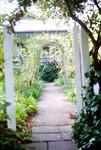
 Climbing Plants
The most common reason trellises are used is for training plants up structures to enable them to reach higher items such as pergolas, the tops of walls and arches. Plants are grown and trained over time till they cover the trellis or reach the required height. When used in this fashion the trellis doubles as a barrier wall and visual plant ‘display unit’. Flower colours, foliage textures and fragrances will be of prime importance for this type of trellis design.
Screening
Whether you cover your trellis with plants or use it as a decorative feature, in either case it will act like a screen. The panels can be used to improve privacy in your garden where required, for example around the spa pool. Alternatively, they can be positioned to restrict the view out of your garden, for example to block the view to a messy neighbour’s yard. Trellis screens are generally cheaper than wall constructions and in many cases more aesthetic.
Space Forming
Trellis structures can also be used to define specific areas within the garden. This serves to give the garden the illusion of space by producing individual ‘rooms’. These ‘rooms’ can create interest to an otherwise ordinary garden. Each of these ‘rooms’ can have a different theme, or can be used for a different function. For example, you might choose to have a recreational room, water pond room, bbq room, Thai garden room and so on.
Environmental Barriers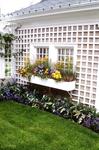
It is possible to use trellises to reduce wind velocity and intensity. A plant cover over the trellis will improve the barrier efficiency. However it needs to be strongly constructed if it is to resist very strong winds with a plant growing over it. Although minor, sound can also be reduced using a plant-covered trellis. One of the principles behind this is ‘out of sight, out of mind’. When a noise producing scene or source is obscured the sound itself seems to diminish.
Barriers
Another purpose of trellis is as a physical barrier to humans and animals. Once erected, a trellis will inhibit adults, children and many animals from passing through that area. A trellis or series of trellises may be used to alter access routes through the yard. They can be used to keep people and animals either in or out of an area.
DIFFERENT WAYS OF USING TRELLIS
Just as trellis has many uses, it can also be installed in many different ways. It is often created as a free-standing fence erected between two upright posts. The trellis panels may be full length, or they may form a capping on top of a solid fence. Similarly, trellis panels are often used to give height and privacy to the tops of garden walls.
It can also be used to create elaborate sides to a pergola, covered verandah, garden arches, gazebo or to decorate many other garden furnishings and structures.
While most trellis is timber it is possible to get trellis made from fibro cement and plastic type materials. These materials have the advantage of not rotting, although they do not have the same aesthetic affect found with timber. The criss cross lattice like pattern may be square or diamond patterned.
Trellis
The ease of installation makes the cost low compared to most other types of fence. Quality varies greatly, and so does price. Cheaper trellis made from timbers such as radiata pine, may only last several years once exposed to the elements, however, good quality hardwood trellis will last a lot longer. Whatever timber is used, you can improve its longevity by maintaining it properly. Ensure that timber is treated for outdoor use, and painted or stained regularly.
SIMPLE TRELLIS SUPPORT CONSTRUCTION
*A normal 2m high timber trellis requires a timber post 8 10cm diameter for support.
*Foundations for a normal fence or trellis should be at a depth of approximately 25 30% of the height of the fence. For example, a 2 metre high fence should be attached to uprights set 0.5 metres into the ground.
*In loose, moist or sandy soils, uprights should be set in concrete.
*In heavy soils, uprights can be set in soil and packed with rubble such as broken bricks, tiles, large stones and so on, which is then compacted by ramming it with a crow bar.
*Any timber poles set in the ground should be soaked thoroughly in a timber preservative such as cuprinol, but care should be taken not to allow such treated timbers to come into direct contact with the soil as they are highly toxic.
*Uprights should be levelled to the vertical.
*When uprights are set, trellis can be attached. It is easiest to order pre-cut trellis from timber yards, as cutting trellis is not only awkward, but the area to be cut may fall half-way across the individual squares.
WARNING
Be careful when using treated pine. Timber preservative used to treat pine does not always impregnate right to the centre of the log. When cut to length you may be exposing an untreated central core which will rot quickly if placed in concrete foundations as a fence support. A second treatment with preservative may be necessary for freshly cut timber ends.
PLANTS TO GROW ON TRELLIS
When choosing your trellis plants consider the following:
- Plants which are too vigorous and grow very large may end up with so much vegetation clinging to the trellis that the trellis breaks or becomes distorted.
- Plants which grow to the light can end up with a lot of foliage on top and little foliage at the bottom. This is not good when you are aiming for a screening barrier.
- Select plants which will give the density of foliage you require. Some will cover the trellis thickly so you can no longer see through, whereas others will allow glimpses of what is beyond.
- Select plants suited to the light conditions of the site. Trellis used in confined positions, such as along the side of a house, should be planted with shade loving plants only.
- Many ideal trellis plants will require training to get them to grow in a two dimensional plane on a trellis.
- Select plants that do not grow too much in terms of stem thickness as they mature, since this may result in the trellis warping and ultimately breaking.
Suitable Trellis Climbing Plants:
| OK in Semi Shade |
Needs some Sun |
Dense Foliage |
Deciduous |
| Hoya |
Rose |
Pelargonium |
Rose |
| Manettia |
Clematis |
Trachelospermum |
Wisteria |
| Billardiera |
Thunbergia |
Thunbergia |
Bougainvillea |
| Hardenbergia |
Hardenbergia |
Pyrostegia |
Mandevilla |
| Clerodendron |
Pandorea |
Lonicera |
Akebia |
| Dilpodenia |
Solanum |
Senecio |
Campsis |
| Cissus |
Bignonia |
Parthenocissus |
|
|
Petrea |
| Plants With Damaging Clinging Parts |
Too Vigorous |
| Hedera (Ivy) |
Lonicera (Honeysuckle) |
| Ficus pumila (Creeping Fig) |
Jasminum polyanthum (Jasmine) |
| Vitis (Grape Vine) |
Ipomoea (Morning Glory) |
|
Passiflora (Passionfruit) |
|
Actinidia (Chinese Gooseberry) |
|
Monstera |
|
Thunbergia grandiflora |
|
Alamanda |
| Small Growing Climbers: |
| Clianthus |
Clematis (some) |
| Ficus pumila |
Hedera (some) |
| Humulus |
Ipomoea (some) |
| Jasminum (some) |
Lapageria |
| Lathyrus |
Manettia |
| Hardenbergia |
Solanum |
| Cissus (some) |
Sollya |
| Tropaeolum (some) |