SMALL, BUT COLOURFUL ALL YEAR ROUND
The smallest gardens are often the most difficult to design.
There are so many possibilities, and such little space available.
It is really important to narrow down your focus, and decide exactly what is the most important thing you need from the garden.
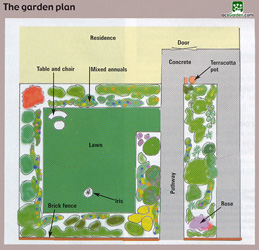
This inner city garden, presented the owners with just such a challenge.
With next to no backyard, and surrounded by concrete, industry and similar small properties; it became obvious that this area needed to satisfy two criteria:
- To provide visual and psychological relief from an otherwise overbearing environment
- To provide a place where the owners could sit, even for only short periods, drink a cup of coffee and unwind a little
Privacy Might Have Been a Problem
Front gardens are often not the place to sit and relax, being on show to everyone who walks down the street. In this case, that was not a problem. Neighbours living at close quarters all know each other, and think nothing of lingering together to relax and have a chat in any front garden. The front garden bed has been planted with slightly taller plants, to provide partial privacy. In this situation, that is not only all that is feasible, but also, all that is required.
Contrast is Key
In this environment, dominated by metal, concrete, brick and overhead wires; it was important to create an environment as different as possible.
The surrounding environment is made up of drab colours and hard surfaces; so this garden has been designed to be dominated by bright colours and soft surfaces.
The Layout
The design is simple but functional; a lawn surrounded by garden bed; and an all weather concrete path edged both sides by garden bed, leading from the front gate to the front door.
When space is limited, it is often better to keep the design simple and focus on creating interest in the way you select and combine plants.
Why no Trees
The design avoids using trees for three reasons:
- Trees in this small space may cause damage to buildings, pipes and paving; and that threat
- Trees create shade, which makes it more difficult to grow bright flowers, and even if they do grow: without direct sunlight reflecting off them, they never look quite as bright
- Gardens take longer to warm up and inner city areas can get particularly cold at night. By having the garden unshaded, it can be warmer sooner in the morning in particular.
Planting
Most of the plants used here are flowering perennials, bulbs and annuals. A careful selection of varieties has ensured some flowers occur all year round, with an increased amount of colour in spring and summer, when the owners tend to appreciate and use their small patch of garden more.
|
| Polyanthus are a favourite addition to provide colour through winter |
|
|
| Feathery pink plumes of Astilbe, mixed with an ever-changing parade of other blooms, provide a colourful and softening edge to the pathway |
|
|
| Planted early in Autumn, poppies continue to keep this garden looking colourful well into winter |
|
|
| A small area of lawn might not seem worthwhile to those of us living on a large block of land but here it provides valuable space for the owners to be outside, appreciate the flowers, feel grass beneath their feet and share a pleasant chat with the neighbours |
|
|
| Splashes of yellow coreopsis flowers emerge in spring and summer every year, shrinking back to a low clump of green foliage over winter |
|
|
| Marigolds are a favourite annual for planting in this garden in early summer. They flower within weeks of planting and provide patches of colour throughout summer and well into autumn |
|
 VISIT OUR ACS ONLINE E BOOKSTORE
- Quality ebooks written by our staff
- Wide range of Horticulture titles by John Mason, author of over 40 gardening books, garden magazine editor, nurseryman, landscaper and principal of ACS.
- Ebooks can be purchased online and downloaded straight away.
- Read on an ipad, computer, iphone, reader or similar device.
- New titles published every month –bookmark and revisit this site regularly
- Download sample pages for free, to see what each book is like.
More from ACS
Ebook - Great colourful reference - professionals, home gardeners: all you need to know to grow bulbs for pleasure and profit.
View eBook
Get a great overview of plant taxonomy, and learn to identify over 100 plants as well as many plant families.
View Course
Enhance your design skills and apply them to various garden styles.
View Course
Ebook - Know what you can grow where and how with this accessible text.
View eBook
Ebook - Types: flowers, vegetables, herbs; garden designs, seasonal displays; selection, care, problems, propagation.
View eBook