Colourful Contrasts
Get greater impact from colour by being careful about how you combine colours in the landscape.
Colourful contrasts in the garden grab your attention and have the potential to turn an ordinary landscape into a memorable garden scene. For the best effect, choose those colours that give the strongest contrasts such as blue and yellow or purple and light green. Remember the colourful contrasts don’t have to come from flowers. Some of the best colour schemes are based on foliage, using evergreen plants for year-round colour or deciduous plants for seasonal highlights. Also look at how the non-living components in your garden could be used to create colourful contrasts – a painted wall, fence or lattice screen is an excellent way to provide a permanent contrasting backdrop to plants grown in beds. On a smaller scale, you could use garden furniture, pots or other decorative features to create small splashes of contrasting colours.
| THE COLOUR WHEEL |
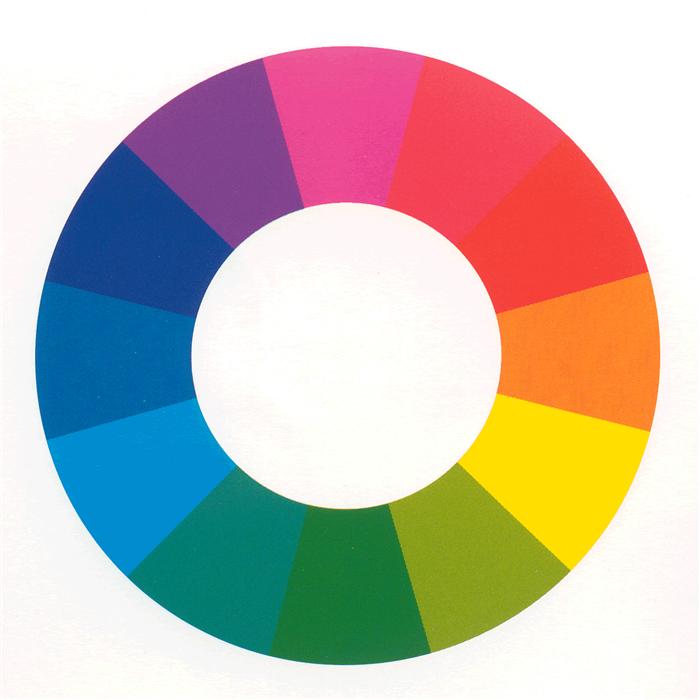 Colour can be thought of in terms of a circle made up of a progression of different colours: each one only slightly different to the one next to it. Red has pink on one side and orange on the other, which are both colours that are created by mixing red with other colours.
|
|
USE OPPOSITE COLOURS
Colours which are on opposite sides of the colour wheel have the greatest contrast so if you want to create an impact, place two opposite colours beside each other. Contrasting combinations include:
- Yellow contrasts with blue or purple
- Purple contrasts with light green
- Darker greens contrast with pinks and reds
- Light blue contrasts with red
- Darker blue contrasts with orange
- White contrasts with dark greens
- Silver contrasts with dark reds, purple and lime green
The simplest contrasts are based on pairs of opposite colours; for a more complex scheme use three or more contrasting colours.
| Light and Colour
The image depends on the type of light and where it is coming from. For example, the colour of a statue looks quite different when it is hit by bright sunlight compared to when the sun is behind and filtered through a canopy of trees.
Light and Colour Work Together
It doesn’t matter how brilliant any flower or feature is: without the appropriate lighting, the colour will never be seen at its full potential.
Time of Day
The colour of a plant or feature in the garden will change throughout the day. The sun gives off energy waves or vibrations – and this is what we see as colour. These vibrations vary in rate and that rate is what creates different colours.
During the day, faster vibrations occur, with the sunlight penetrating the atmosphere at right angles more directly, and the faster vibrations cause the sky to appear blue.
At sunset, the sunlight is coming into the atmosphere at a greater angle, and this causes slower vibrations that make the sky appear more yellow or orange. Similarly, the colour of flowers may vary during the day. Sapphire blue colours can look more lilac or purple in late afternoon light.
At night, things appear as shades of black grey or white unless lit artificially; and then the type of light source can change the colour.
|
|
| Contrasting coloured stones can be used to create striking paths. |
|
|
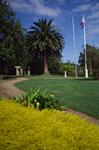
| Gold Foliage makes a stunning but warm contrast with deep timber tones |
|
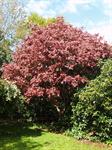
| Place dark foliage against a pale background to create a contrast |
|
Creating Colour Contrasts in the Garden
- If you have lots of green foliage, plant a reddish coloured foliage plant as a hedge through the centre or a patch of coloured foliage plants in the foreground.
- If a feature (eg. a statue or fountain) lacks impact, give it a contrasting backdrop. Surround it with bright coloured plants or paint an existing wall or fence behind it in a contrasting colour.
- If you are installing a lattice or trellis panel against a wall, try whitewashing the wall and choose a dark bold colour for your trellis. Deep blues and greens will stand out well and emphasise this feature.
- Consider contrast when planting up containers. Pale, silvery bark or foliage contrasts well against terracotta. Dark green foliage contrasts well against pale stone colours. If using painted wooden containers select the colour to contrast with the plants you intend to use.
- Containers can be strategically placed to contrast with trees and shrubs already growing in the garden.
- You can try using contrasting blocks of different coloured foliage in garden beds. A central garden bed can look captivating with plantings of red, silver and green opposite each other.
- Similarly blocks of dark green and light green can be used opposite each other.
- Use contrasting coloured pavers on pathways and patios to create interesting patterns
- Paint archways and pergolas in colours that contrast with the foliage and flowers of climbers growing up them
- Use a white stone mulch in pots containing dark foliage plants, and a dark stone mulch in pots containing silver foliage plants
|
USE PEBBLES and GRAVELS TO CREATE CONTRAST
Pebbles and gravels are back in fashion. They are a versatile option – equally useful as a mulch around garden plants or as a hardwearing surfacing for paths, driveways and around buildings.
In their natural state, colours include earthy browns and reds, subdued greys, and black and white, and these can be used to good effect in the garden. For example, dark foliage plants could be surrounded by stark white pebbles and edged with dark-coloured bricks.
For modern garden designs, artificially coloured pebbles and gravel are the latest trend. These are available in an array of bright and quirky colours and in themselves can be a major feature of the garden. They can be placed in patterns or blocks of contrasting colours as an eye-catching feature.
|
| The dark topiary foliage shapes are accentuated against the pale walls of this house |
|
|
| Select stones that are much paler than surrounding foliage when installing paths |
|
|
| Garden furniture can be used to create contrasts with paths, structures and foliage |
|
|
| You can paint containers to give vivid contrast against the foliage; the red and green shown here are at opposite ends of the colour spectrum |
|
|
Golden Hedge foliage is highlighted against the dark backdrop
|
|
|
| Solid structures can be painted in a variety of colours to provide a contrast with each other as well as with the foliage |
|
Want to Know More?
Consider doing a course or buying a reference book from our school.
If you would like to communicate with one of our professional tutors, consider using our free course counselling service. click for details
If you want to browse our bookshop, go to www.acsbookshop.com
 VISIT OUR ACS ONLINE E BOOKSTORE
- Quality ebooks written by our staff
- Wide range of Horticulture titles by John Mason, author of over 40 gardening books, garden magazine editor, nurseryman, landscaper and principal of ACS.
- Ebooks can be purchased online and downloaded straight away.
- Read on an ipad, computer, iphone, reader or similar device.
- New titles published every month –bookmark and revisit this site regularly
- Download sample pages for free, to see what each book is like.
More from ACS
Ebook - Inspiring: covers formal, natural, eclectic, modern, oriental, Mediterranean; zoom in on stunning images and plans.
View eBook
Ebook - Explores garden design ideas and inspires
garden design and landscaping!
View eBook
Enhance your design skills and apply them to various garden styles.
View Course
Ebook - informative guide: care, use selection and lots of coloured pics.
View eBook
Course - draw designs, survey sites, understand plants, soils, timbers, climate, and other landscape materials pivotal to the success of a good landscape design.
View Course